This is the first in a three part series discussing software monetization. The series will focus on the oft-overlooked area of desktop software; and starts with how to price your software.
Choosing how to price your software is one of the hardest decisions you can make as a product team. Pick the wrong model, and customers might never bite. Set the wrong price, and you leave money on the table or, worse, chase customers away.
In this article we’ll break down common pricing models and give you a simple, practical way to think about how to choose between them and how to set the price point.
Good pricing does three important things:
Whether you are targeting enterprise, prosumer, or consumer markets, the answer shouldn’t be “just pick a number.” It’s about picking a model that matches how customers use and value your software.
Pricing desktop software is fundamentally different from pricing cloud services. Once your software is shipped as a binary, it can be installed, copied, and run in environments you may never see. That reality shapes every pricing decision you make.
Pricing desktop software is different because the software often runs:
Once delivered, the software may remain in use for years without connecting to the internet. This means pricing models that require “phoning home” for license enforcement may not work. For example, if a subscription needs an internet connection to renew, then that could be problematic is a truely air-gapped environment.
As a result, desktop software pricing and licensing are closely linked. A pricing model that cannot be enforced reliably will leak revenue, no matter how well it looks on paper.
Unless your software requires a unique pricing model, it is a good idea to select from the common models in use today. Doing so means your potential customers will find your pricing familiar and easy to understand. This reduces friction in the buying process.


The most common models you’ll see in software today are:
A perpetual license allows customers to buy the software once and use it indefinitely.
It works well when:
Perpetual licenses are still common in engineering tools, creative software, and specialist utilities. The benefit is that you get the money upfront, but the trade off is that revenue stops after the sale unless upgrades are paid for separately.
This hybrid model combines a one-time license fee with an annual maintenance or support contract.
Maintenance typically includes:
Customers keep their licensed version forever, but must renew maintenance to stay current.
If considering a hybrid model, extra consideration needs to be given to revenue enforcement. For example, PACE offers Release Date Limits (RDL) which can be used to limit a customer to versions of your product from a given date range. This allows a perpetual license to be given to the user but only binaries with a specified release date will run. This enables you to provide perpetual licenses that limit updates and maintenance releases to a timeframe of your choice. In other words, it allows you to sell perpetual licenses while monetizing time limited support contracts.
A hybrid perpetual plus maintenance model offers a balance between customer control and vendor sustainability and remains one of the most effective approaches for professional desktop software.
Subscription models charge customers regularly to continue using the software.
For desktop products, subscriptions mean:
To work well, subscriptions for desktop software rely on strong licensing to enforce subscription policies and terms. That strong licensing needs to have in-built subscription support (e.g. grace periods) to avoid unnecessary customer friction.
Subscriptions work best when regular updates deliver clear ongoing value and renewal processes are automated.
A Rent-to-Own (RTO) license is a hybrid licensing model that allows users to make recurring payments for software over time with the option to gain full ownership after a certain number of payments.
For desktop products, rent-to-own means:
This model appeals to users who want to eventually own the software but may not be able to afford a large upfront purchase. Rent-to-Own licensing systems must be capable of tracking payment milestones, transitioning licenses from temporary to permanent status, and enforcing conditions during the rental period.
Many desktop products offer multiple editions with different capabilities.
For example:
This allows you to serve different customer segments without fragmenting the product.
There’s no single answer that fits every product; and product success is about meeting the needs of customers rather than simply following the competitions. Therefore, instead of starting with trends, a good approach is to start with constraints. Begin by asking yourself:
If your software must run fully offline or in controlled environments, perpetual or hybrid models are often more realistic than pure subscriptions.
If customers expect frequent updates, subscriptions or maintenance renewals become easier to justify.
How do your customers prefer to buy? Professional users often compare your pricing to established tools in their field. A pricing model that feels out of place can block adoption, even if the product is strong.
Talk to customers early. Resistance to pricing models needs to be taken seriously.
If steady growth and forecasts matter, subscription models are generally stronger than perpetual as by their nature they deliver recurring revenue. Even enterprise tools are moving to subscription for this reason.
The challenge with perpetual licensing is that it can be hard to generate follow-on revenue for customers. When deploying a perpetual model thought needs to be given to how to generate additional revenue e.g. Will you charge for maintenance? Do you intend to release new versions which will require an upgrade fee on a regular basis?
Once you have a model, you need a number: the price. The aim is to get that number to match the perceived customer value.
Step 1

Customer Value

Step 2

Market Anchors
Step 3

Test & Learn
Here’s a simple framework:
You are the expert in your software. You know why you built it and the use cases it enables. If you haven’t already, now is the time to think about what those use cases mean in monetary terms. Ask yourself:
The point here is that price should be a fraction of the value delivered, not a reflection of development cost. Let’s be clear, your potential customers don’t care what it costs to build the software, what they are willing to pay for is the value it brings to them.
To put that another way, “cost-plus” models don’t optimize your revenue. If the cost is greater than value, then customers simply won’t buy (and you have a bigger problem!). If cost-plus is lower than the value, you are leaving money on the table.
Find similar products and compare your estimated customer value to their pricing.
This anchors your pricing to market reality. Which helps avoid pricing that feels arbitrary or disconnected from expectations.
The first two steps have given you a pricing hypothesis – a pricing model and price point that feels right but hasn’t been market tested. The next step is to test the pricing by talking with target customers.
It’s maybe stating the obvious, but don’t ask customers how much they’d pay. You need to be more subtle and triangulate multiple data points to find the right price point.
For example, as price is often a quality indicator to buyers, you can present a price point and ask about how it aligns with the perceived quality of your product.
Price testing shouldn’t stop when you launch your product, in fact, it’s really only the beginning. You need to continuously monitor:
Don’t think of pricing as a one-time decision. It’s about constantly learning and adapting. Start by choosing a model that aligns with how your customers use and value your software, then set your price by estimating value, checking the market, and testing with real users.
Good pricing helps you grow sustainably. The best pricing models align customer expectations, licensing realities, and sustainable revenue. When those three are in balance, pricing can be a strength to your business.
Continue with part two: e-commerce
Skip ahead to part three: protecting your revenue and investment
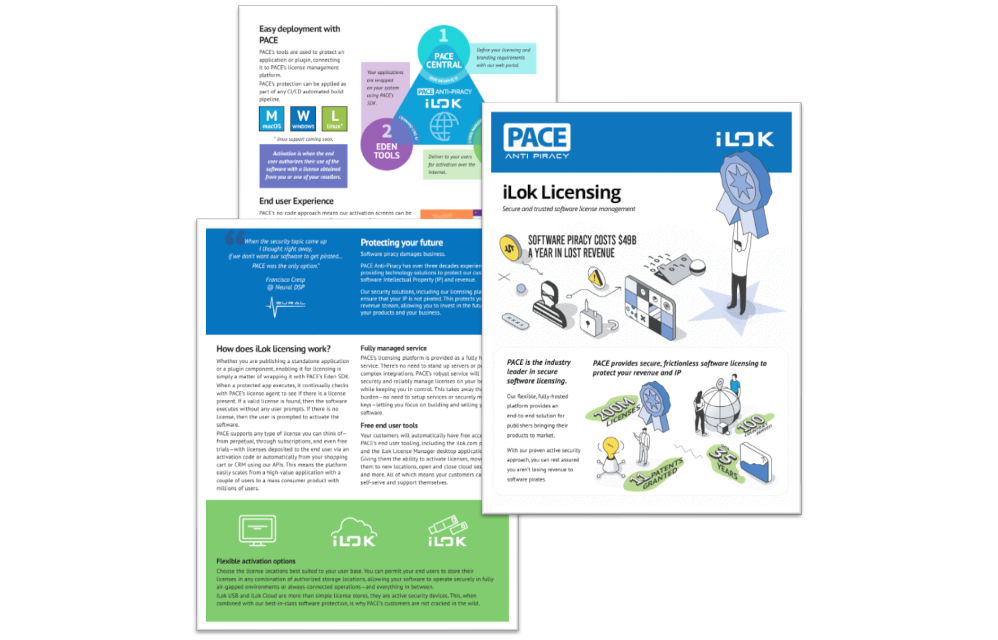
Download the iLok Licensing product brochure to learn more about how PACE's software licensing platform protects your IP and allows you to maximize your value.