This is the third and final article in our series on monetizing desktop software. The first part looked at pricing considerations and the second at how to sell through e-commerce channels. This part looks at how to protect your revenue and investment from pirates and reverse engineers looking to steal your intellectual property (IP).
With software piracy costing businesses $46B annually, taking steps to protect your investment is key to sustaining your revenue and growing your business.
This article explores the risks from piracy (which stretch further than simply lost revenue) and steps you can take to help ensure that value is preserved long-term.
Software piracy is often treated as a revenue problem: lost sales, lost licenses, lost opportunity. While those impacts are real, they only tell part of the story. In practice, software piracy creates a wide range of risks that affect not just software vendors, but also customers, partners, and entire ecosystems.

Software is easy to copy and distribute digitally. Without strong protection, this makes piracy easy too. For many businesses, especially those selling desktop or professional software, this creates exposure that goes far beyond simply lost income.
The most obvious risk of piracy is financial. When software is used without a valid license, vendors lose direct revenue. Over time, this can significantly affect cash flow, pricing strategy, and investment decisions.
Piracy also distorts the market. When some users get the product for free, paying customers may question pricing or fairness. This can cause pressure from legitimate customers and force vendors to lower prices or reduce features. For smaller companies, sustained piracy can threaten long-term viability and make it harder to fund development, support, and innovation.
Software piracy is not just about free use. In many cases, software is reverse engineered, modified, or repackaged. This exposes proprietary algorithms, workflows, and techniques that represent years of research and development.
Once intellectual property is extracted, it can be reused by competitors, embedded into counterfeit products, or resold under different branding. Unlike physical goods, stolen software can be duplicated endlessly at near-zero cost. Once IP escapes, it is almost impossible to recover.
Pirated software is a major security risk for users. Unofficial downloads are one of the most common ways malware is distributed. Attackers often bundle ransomware, spyware, or backdoors into cracked installers.
For businesses, this creates a hidden cost. Users running pirated software may still seek support, report bugs, or blame the original vendor when something goes wrong. Worse, compromised systems can lead to data breaches, regulatory violations, and reputational damage — even if the vendor had no direct involvement.
Piracy weakens brand control. Modified or cracked versions of software may behave unpredictably, crash more often, or disable safety features. When users encounter problems, they often associate them with the brand, regardless of the fact they are running an illegal copy.
This is especially serious for professional, creative, or safety-critical software. Poor performance or failures caused by tampered versions can erode trust and damage a reputation built over years. In regulated industries, such as healthcare or engineering, misuse of pirated software can also create legal and ethical concerns.
Ironically, piracy often increases costs for vendors. Support teams spend time dealing with issues caused by unauthorized copies. Engineering teams may need to respond to exploits used to bypass protections. Sales teams must manage pricing pressure caused by widespread illegal use.
All of this diverts resources away from improving the product for legitimate customers.
Given the risks that software piracy and reverse engineering bring to your business, it is important to protect your software. This makes software licensing one of the most important tools for protecting revenue. At its core, licensing defines who can use your software, how it can be used, and for how long.
Software licensing should be there to support your business so what are the key considerations when choosing a platform?

Modern customers expect instant access after purchase, with no manual steps or delays. Licensing systems must integrate cleanly with e-commerce platforms so that every transaction reliably triggers license creation and delivery. Manual fulfillment may work at small scale, but it quickly becomes expensive, error-prone, and difficult to support as transaction volumes grow. Automated licensing reduces operational cost while ensuring every user receives exactly what they paid for.
Another important factor is flexibility. Users upgrade machines, work offline, and move between environments. Licensing systems should support these real-world workflows with features like license transfers, offline activation, and device limits. When licensing is too rigid, customers look for ways around it. When it’s well designed, it becomes an enabler rather than a barrier. The goal is to raise the cost of abuse without punishing legitimate users.
A licensing platform’s ease of deployment and support overhead is key in maintaining engineering velocity and allowing your business to scale. A system that is difficult to integrate, configure, or maintain will slow down releases and increase the burden on engineering and support teams. Developers need licensing tools that fit naturally into existing build, CI, and release pipelines.
Just as important is what happens after launch: licensing issues have the potential to become a common source of support tickets. A good licensing platform reduces support overhead by handling common scenarios like activations, machine changes, offline use, and recoveries in a self-service way, allowing support teams to focus on real customer issues instead of fixing licensing problems.
Desktop developers also need to think about the strength of protection a licensing platform provides. A license that can be easily bypassed offers little real protection. Basic serial numbers or simple file checks are often shared online within days. Effective licensing should be tightly integrated into the application, making it difficult to remove without breaking functionality.
PACE’s iLok Licensing is designed specifically for long-lived, professional desktop software. It provides:

Software developers choose iLok because it provides proven, professional-grade licensing that protects software revenue without disrupting legitimate users. With flexible license models, strong anti-piracy protection, and seamless integration into desktop workflows, iLok lets developers focus on building great software while maintaining control over how it’s sold and used.
Protecting your software is ultimately about protecting the value you’ve worked to create. Pricing and e-commerce determine how customers buy, but licensing determines whether that value holds over time. Without strong protection, piracy, reverse engineering, and misuse can quietly erode revenue, increase support costs, and weaken trust in your product. A well-designed licensing strategy helps ensure that the customers who benefit from your software are the ones who support its continued development.
For desktop software developers, licensing needs to do more than block abuse. It must scale with your business, integrate cleanly with your sales channels, and support real-world workflows without frustrating legitimate users. Automation, flexibility, ease of deployment, and strong security all play a role. When these pieces work together, licensing becomes an enabler. It supports growth, simplifies operations, and preserves intellectual property.
If you’re looking for a proven way to protect your revenue and investment, learn more about iLok Licensing from PACE. Designed specifically for professional desktop software, iLok helps you secure your IP, reduce support overhead, and deliver a smooth experience for your customers. Visit the iLok Licensing page to see how it can support your monetization strategy and help safeguard your business for the long term.
Go back to part two: e-commerce
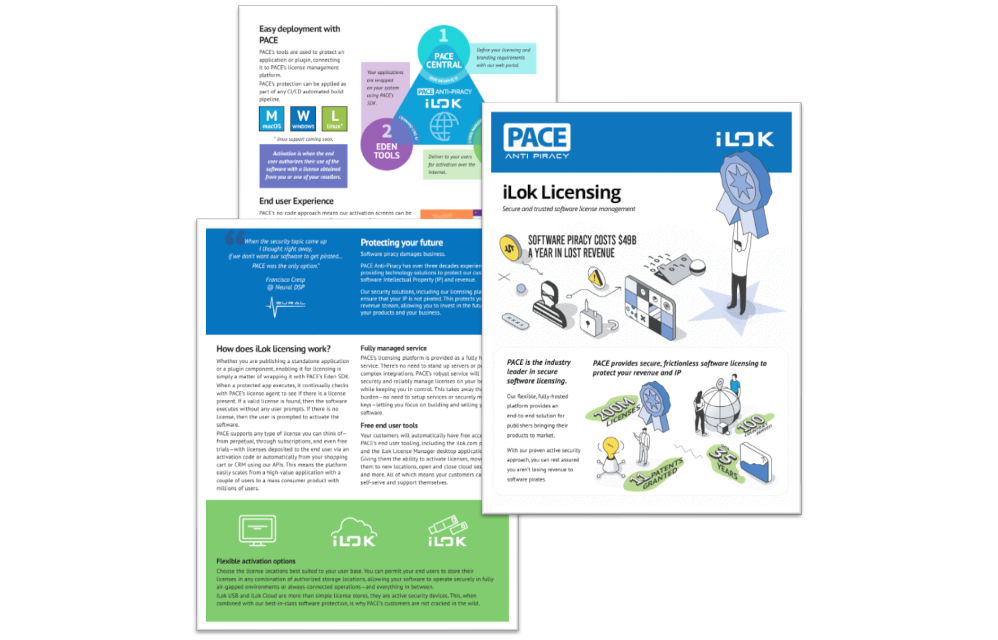
Download the iLok Licensing product brochure to learn more about how PACE's software licensing platform protects your IP and allows you to maximize your value.